How to Catch a Dragon
Caryl Hart & Ed Evans
I have an incredible habit of pickling up picture books that end up being about libraries. This one has a beautiful big dragon on the front, and this month, Share a Story is celebrating the theme of dragons. I have been visiting nurseries and primaries, telling stories and creating opportunities for learning and creativity, with the book, Too Hot to Hug. But having read that a number of times, I thought I'd treat myself to another dragon themed story.
Albie's homework is to draw a dragon, but if he has never seen one, how can he draw one? When his mum takes him to the library, Albie tries to find a book that might help, but a chance encounter with a young knight leads him on an adventure full of dangers and monsters - he must be very brave to make it through.
How to Catch a Dragon is a generous story, in which kindness and friendship is celebrated, and libraries are praised as sources of inspiration and fuel for the imagination. It is through his creativity and willingness to explore the library that Albie manages to make friends and complete his homework.
How to Catch a Dragon
Caryl Hart & Ed Evans
I have an incredible habit of pickling up picture books that end up being about libraries. This one has a beautiful big dragon on the front, and this month, Share a Story is celebrating the theme of dragons. I have been visiting nurseries and primaries, telling stories and creating opportunities for learning and creativity, with the book, Too Hot to Hug. But having read that a number of times, I thought I'd treat myself to another dragon themed story.
Albie's homework is to draw a dragon, but if he has never seen one, how can he draw one? When his mum takes him to the library, Albie tries to find a book that might help, but a chance encounter with a young knight leads him on an adventure full of dangers and monsters - he must be very brave to make it through.
How to Catch a Dragon is a generous story, in which kindness and friendship is celebrated, and libraries are praised as sources of inspiration and fuel for the imagination. It is through his creativity and willingness to explore the library that Albie manages to make friends and complete his homework.
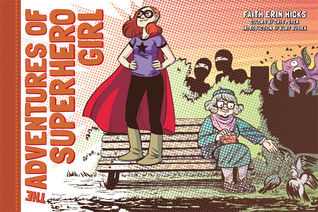
The Adventures of Superhero Girl
Faith Erin Hicks
This unexpected treat I found in the children's section of Cardiff Central Libraries, during a day I spent "researching" the resources there. (I was finding materials for story time and got distracted in the graphic section.)
Superhero Girl is a completely terrible superhero, especially compared to her brother, who takes on the world and handles the fame of his status with ease and composure.
And yet it is Superhero Girl that I would like to be - terrible with romance, impoverished by lack of income, and pretty useless at maintaining her secret identity. Her missions are somewhat mediocre - rescuing cats from trees, placating her overzealous mother, etc. - but that makes it all the more brilliant when her arch-nemesis finds himself chosing between continuing in a career of evil and a more conventional profession.
This comic stemmed from a blog, which you can find here: http://superherogirladventures.blogspot.co.uk/; and author Faith Erin Hicks is very vocal and entertaining on social media. She is definitely worth following.
On the Road
Jack Kerouac
London, Vintage
Oh the irony of this being the first book I am reading in my new life. This was meant to be the last book I read in my Staff Book Club, but due to life being mad over the holidays, I finished it a little later than usual.
In the late forties, Sal Paradise (what a name!) sets off from his aunt's home in New York on a series of national adventures. Dean Moriarty is the cause of each - an eccentric, energetic young man who inspires Sal to cross America to Denver, San Francisco and finally into Mexico. Their trips are fuelled with drugs, drink, and sex, and are enabled by hitch-hiking and borrowed cars.
Along the way, the men tell share everything with each other, from childhood memories to lose change to women. The novel explores masculinity in a time and place where the future seemed uncertain and the past haunted your every step. Young men were better educated than past generations; the threat of nuclear war hung over their heads, but they were not sent to Europe to fight on the front lines like their fathers. Equally, the American dream thrived in post-war success; and Sal and his friends push the boundaries of this ideal to the very limit.
On the Road is written in Kerouac's well-known stream of consciousness style (not that I would actually know, having never read his work before). Great paragraphs flow through the pages, describing scenes of marijuana-filled ecstasy or beer-crazed jazz clubs.
I didn't particularly like the characters in this book - the men were all selfish and the women were uninspiring - but I loved the way the story was told. Each part contained a new trip, with new faces and new towns. And each journey felt like a struggle - a battle with long, dull roads, against broken down cars and jobsworthy policemen, with limited money and no end goal.
But every time they returned to their normal lives, they found themselves bored of the mundane nature of the every day; so unable to stay still for long, Sal and Dean would set off again for another journey.
All it makes me want to do is book some flights. Somewhere. Anywhere.
Ruby Redfort: Catch Your Death
Lauren Child
London, Harper Collins, 2013, 525p
I have been searching for a suitable book for the OSA Y7 Girls Book Club, due to start after Christmas, and I really wish this book was shorter - it is perfect in every other way!
Ruby's third mission takes her completely outside her comfort zone. Ruby is undergoing field training; despite the fact she has already been involved in many dangerous missions, she needs to complete this to become a fully-fledged Spectrum agent. But the wilderness test baffles her practical approach to danger; she cannot escape the unpredictable nature of the outdoors.
Catch Your Death is the smelliest mission yet, in the sense, alongside all strange animal attacks happening throughout Twinford, a perfume-obsessed foe is haunting the town. And following an difficult night in the woods, Ruby has the flu, is unable to smell anything, and is struggling to keep on top of her school work and her Spectrum duties.
I am a self-confessed fan of Ruby Redfort - I would have devoured Lauren Child's words when I was a kid, even more so than I devour them as an adult. I get completely lost in Ruby's adventures. In this third mission, her best friend, Clancy, seems to get a much bigger role - he is finally being recognised as a hero like Ruby. And he is fiercely loyal to her.
In places, the physical book; something I noticed with the previous novels, also. There are pages where a new scene begins, but there is no distinction from the last page, meaning you have to stay on your toes to work out who you are reading about. (And I do not see this as an intentional ploy to get readers to practice their observations skills, simply an editorial mistake.)
Nevertheless, the story is action packed and the book does not feel as long as it looks. You are completely drawn into the action, following Ruby and Clancy every step of the way.
Assassin City / Switch Face
Jonny Zucker & Pedro J Colombo / Jonny Zucker & Kev Hopgood
London, Franklin Watts, 2013
There is nothing like a good short read to get me back into younger fiction, albeit slowly. Luckily, I read two!
In Assassin City, Milo is given a task and he has no choice but to follow through. He does not want to be an assassin, so plots with Kira to try and find a way out.
Switch Face is the story of a boy who can change his face to look like another person, providing he has an image from which to take inspiration. At school, he borrows a mate's passport to get him into trouble, and adopts the Headmaster's face to boss people around. But his antics place him in danger when he finds himself on the wrong side of the law.
Best of all, Switch Face is a cliffhanger - it is so short, with so much packed in, that it leaves you begging for more.
 Franklin Watts are legendary for their short read fiction and non-fiction, and with these new graphics, they have really hit the mark. They are brightly illustrated, action-packed and ideally low on the Accelerated Reader scale at just 1.7 / 1.8.
It is really hard to find books at the lower scale of the Accelerated Reader program - my stock in that area is pretty thin, though most of the books in that section are exceptional. But I am so glad I have this new (at least, new for my library) selection of Franklin Watts to entertain those reluctant boys who are so easily distracted in lesson.
Ruby Redfort: Take Your Last Breathe
Lauren Child
London, HarperCollins, 2012, 415p
My love for Ruby Redfort has already been loudly declared. I moved quickly from the first book in the series to the second, just as Ruby moved from her first adventure to the next.
The danger is established early in the novel, as Ruby is subject to diving training and educated extensively about all the risks of being at sea. But Ruby doesn't see much to be afraid of, until strange things start happening - people disappearing, claims of noises luring people into the deep. And when a Spectrum agent succumbs to the deep, it quickly becomes a priority for all recruits.
In Take Your Last Breath, the danger is once again very close to home, as Ruby's parents are caught up in drama at sea. As a meteor passes by the earth, tides start to settle, and things that have been left in the deep suddenly rise to the surface. An ancient family heirloom, surrounded in
There is layer upon layer of mystery in this novel, as Ruby uncovers increasingly more powerful sources of evil. But she is not alone - Hitch, her butler / secret agent, is always watching her back, and her best friend, Clancy, is as smart and quick as she is.
(Talking of which, I am a little disappointed that Clancy's talent has not yet been recognised by Spectrum. They should recruit him, too.)
It's been a mad week, but I have been glad to have had Twinford to escape to, and the next book is already sat on my shelf awaiting my attention.
Breathe
Sarah Crossan
London, Bloomsbury, 2012, 371p
I have been trying to read this for the last few days, with little success. I am unsure if it is because it is the holidays and I have switched off, or because the book isn't all I wanted it to be, but I have not gotten very far.
One hundred pages in, the characters are introduced and the plot is established, but I am not gripped. Alina, part of a rebel group, is forced to escape the city in which she has always lived. Here, oxygen is a gift, divided according to a strict social divide, which leaves many without enough air to lead a normal life. The state is catching up with the rebel group, and Alina must get away. On the city borders, she is helped by a Premium boy, one of the rich and fortunate, and together they escape into the unknown outside the Pod.
Already, the path of their story seems clear, paralleling many of the tropes of the multitude of other dystopian novels currently available. On reading the blurb, I loved the concept of this novel, but the initial pace felt slow and I could not engage with the characters and their trials.
Perhaps I just need a holiday and will return to it in the future.
Cakes in Space
Philip Reeve
ill. Sarah McIntyre
Oxford, OUP, 2014, 213p
Astra is both nervous and excited about her one hundred and ninety nine year journey from Earth to Nova Mundi, a planet where a select few are being sent to establish a base for people to move to. She is a little peckish before her journey, and accidentally breaks the Nom-o-Tron, a machine designed to make any food she wishes.
But halfway through the journey, she is woken from her space pod to discover the space ship is overrun with evil cakes, created by the Nom-o-Tron after some confusion about her snack request. With her robot friend, Pilbeam, Astra must fix the Nom-o-Tron and set the ship back on it's correct course.
Cakes in Space is a delightful, merry jaunt through space - I adored Astra's innocence, determination and bravery, and felt like I was taking an adventure with her.
Unfortunately, I only have a proof copy of this book (it comes out in September), meaning the illustrations are not all completed. Yet, within just a few pages, you get a great idea of Sarah McIntrye's skill and what the pages will look like - full of bold pictures with colour spilling over the pages - simply gorgeous!
Now I have to go back and read Oliver and the Seawigs, which I know I should have read long ago!
Allegiant
Veronica Roth
London, HarperCollins, 2013, 526p
It has taken me a little longer to read this final book in the Divergent series than the previous two. When I started it, I jumped right in, eager to find out what happens to Tris and Tobias, but I found this book slower paced and less gripping than Divergent and Insurgent.
It's hard to write about this novel without giving anything away. Let's just say this: Tris, Tobias and their friends learn that the world they have known is not what it seems. As the city divides - people choosing whether to defend the system of factions or battle for factionless society, it becomes clear that the city is only a small part of a greater plan, and the young characters begin to see themselves as tiny elements of a much greater world.
Here, everything becomes a little science fiction, which is where I lost my connection with the series. Where I had previously loved the dystopian action - pages filled with fights and Tris' inner turmoil - the final book in this series felt like it got too big for itself. It felt a little like the Resident Evil books, where each new story reveals a darker and larger conspiracy. Veronica Roth clearly had a big plan for her series, but this novel did not seem to fulfil her ambitions.
Allegiant is written from the points of view of both Tobias and Tris, switching between the two narrators chapter by chapter and revealing Tobias' inner most thoughts and fears, particularly as their romance developed. Unfortunately, although Veronica Roth has created a clear and complex character in Tobias, I did not find his narrative all that distinct from Tris' and sometimes had to flick back to the start of a chapter to work out who was talking. Apparently, Roth has written some mini-chapters from Tobias' viewpoint previously, and I would be interested to read these and see if they are any better.
When I spoke to the students at school about this book, those who hadn't read it were excited by the final novel in their nre favourite series, and those who had read it convinced me it got better at the end. Admittedly, as the revelations unfolded and the action built up, I rediscovered my love and respect for Tris and her companions (increasingly, the other female characters became intriguing, particularly Christina). But I cannot ignore my disappointment at the turn this series took towards science fiction and that it just felt a little too much like dragging myself through tar.
 Insurgent
Veronica Roth
London, HarperCollins, 2012, 525p
Insurgent
Veronica Roth
London, HarperCollins, 2012, 525p
Good and evil are never as clearly defined as they first seem. Divergent convinced me that the Dauntless were the best of the factions - the brave and noble warrior types - but Insurgent shows that their aggression comes at a cost, and perhaps we all need a little of every faction to be balanced individuals.
Following the devastation inflicted by the Erudite at the end of the last novel, Tris and the Dauntless find themselves lost and divided - some have allied with the information-hungry Erudite whilst others have gone into hiding, taking refuge with the kind Amity faction. The Amity are reluctant to take sides, but are put in a difficult situation when threatened by the Erudite, knowing full well they are in a dependent situation.
The Dauntless traitors continue to spread the Erudite simulation serum through the other factions, preparing an army of mindless drones. Tris suspects there might be more to the Erudite mission than power - old Abnegation leaders have implied that the Erudite are keeping a secret and that all the factions deserve to know the truth.
Throughout Insurgent, Tris battles with depression - she feels like she has lost everyone she loves and is haunted by guilt over what she did during the heat of battle. Try as he might, Tobias cannot seem to do the right thing, and Tris finds herself building up walls and keeping secrets. Tris could have easily become an annoying, moany character in this novel, but Veronica Roth is a talented and engaging writer who maintains the reader's sympathy during the hardest of times.
I absolutely devoured this book - I was impressed to find that it can be added to that short list of brilliant sequels along with Toy Story 2 and the second Godfather movie. Now the characters are well developed and the direction seems clear, the novel flows at a fast pace, with drama at every turn, and with a complete disregard for conventional the good vs evil dichotomy. Nothing is as it seems.
 Boom!
Mark Haddon
London, Red Fox, 2009, 195p
At Oxford Spires, we will shortly be launching our 2013-2014 First Story anthology, and this year our special guest is Oxford local author, Mark Haddon. I adore his writing, but it has been some time since I have read anything from his repertoire, so thought I would rectify that by reading Boom!
Boom!
Mark Haddon
London, Red Fox, 2009, 195p
At Oxford Spires, we will shortly be launching our 2013-2014 First Story anthology, and this year our special guest is Oxford local author, Mark Haddon. I adore his writing, but it has been some time since I have read anything from his repertoire, so thought I would rectify that by reading Boom!
Jimbo and Charlie are adventurous, mischievous boys, often up to no good. So when they land themselves in intergalactic trouble, they know no one will believe them, a little like the boy who cried wolf. It all starts when they use a walkie-talkie to listen in on their teachers' conversations, which leads them to discovering that some unusual staff members talk in a strange language. When Jimbo wants to back off, Charlie pushes full steam ahead, determined to find out what is going on. But Charlie disappears, and Jimbo knows he has to go and rescue his best friend.
'Strange' doesn't even begin to describe this book. It is the weirdest adventure story I have ever read, but so brilliantly crafted that I could not help but become engrossed. Haddon has created a weird and wonderful alternative universe - a planet recruiting human sci-fi fans to keep it going.
As Haddon notes in his introduction, this is not his first attempt at this story, but an intricately edited version. But he got it perfectly right with this peculiar adventure, mixing comedy, the supernatural, and
 Thirteen
Tom Hoyle
London, Macmillan, 2013
Thirteen
Tom Hoyle
London, Macmillan, 2013
When stuck for what to read, I asked a colleague what she might choose at random from the shelves of my library. Being a lover of action stories, she selected Thirteen, the first novel from debut author Tom Hoyle.
The People are a mass of individuals who believe that a boy born at midnight at the dawn of the millennium will prevent the rise to power of The Master, leader of their cult. Thirteen boys were born at this hour, and The People have killed all but one: Adam Grant still walks free, completely oblivious to his fate. He is adopted, with no idea when he was actually born or what his birth is prophesied to cause.
My colleague and I were both intrigued by the pretext for this novel. It reminded me of the pretense of Michael Grant's Gone series, which I have not yet read but have heard highly praised. I like the idea of a group of teenagers fighting for their lives, with little support or structure from the adult world - for young readers, this is a world they dream of living!
And yet I couldn't engage with Hoyle's novel. I felt the pace lagged and the characterisation was incomplete, leaving me longing for more detail and drama. I skipped ahead, and still nothing seemed to be developing: though the plot jumped back and forth between The People's attempts to destroy the Thirteen and Adam's quest to stay alive, the action was stale.
So despite thinking the pretext for this novel sounded incredible, I was disappointed that it didn't seem to go anywhere. And I hate being unable to finish a novel.
Rooftoppers
Katherine Rundell
London, Faber & Faber, 2013, 278p
As I neared the end of this book, I had no idea how it would possibly come to it's conclusion with so few remaining pages. After a slow and leisurely build up, I was impressed that everything managed to come to a conclusion so quickly and smoothly.
When Sophie is orphaned in a shipwreck, she is adopted by the eccentric and loving Charles. He teaches her about books and dreams and she learns to never ignore a possible. But as she grows up, the authorities become increasingly concerned about whether it is appropriate for Charles to remain her guardian, as she is less feminine than is expected of her time. So hiding on rooftops from the authorities, Sophie sets out to find her mother, presumed lost in the wreck, but Sophie still has hope.
The opening of the novel is rather slow of pace - you are introduced to Charles and Sophie and their little domestic absurdities, which I loved. For Charles, education is the most important thing to distill in his ward, but the children's authorities have other ideas about how a girl should be raised. Considering the novel is caused Rooftoppers, much of the book was given over to Sophie's life with Charles, so that I found myself missing Charles' peculiarities once Sophie took to the roofs.
This is Katherine Rundell's debut novel, so it can be forgiven that the balance between introduction and "rooftopping" did not seem quite right; especially since her prose style is so inviting and soothing, written like a classic children's fairytale with feisty modern characters and a dangerous path of adventure.
To see the rest of my Carnegie reviews, click here.
Liar & Spy
Rebecca Stead
London, Andersen, 2013, 180p
Last term, my colleague, Hannah from Oxford Youth Works, and I embarked on establishing a Girl's Book Club for Year 7. Now, we are making some of the boys happy by making a club exclusively for them, using Rebecca Stead's Liar & Spy as our book for discussion.
Georges is a funny, clever narrator. There is a lot going on in Georges' life when he moves into a new apartment and meets Safer, a skilled spy. Safer invites Georges to join his spy club, the main mission of which is to find out what is going on in the apartment of the mysterious Mr X. As time goes on, Safer becomes more demanding, and Georges starts to question if the friendship and the spy club are worth sacrificing his morals for.
Yes, the names of these characters are rather strange, but seeing as the whole story is delightfully uplifting, it doesn't really matter. And in some ways, the friendship between the boys is strengthened by their mutually unusual names.
Although the main plot focuses upon the spy club, Georges and Safer both have issues they are struggling with and unwilling to share. The club helps distract them from their hopes and fears, but also helps them process some of the challenges they are facing.
Georges is an adorable protagonist - I love Rebecca Stead's style and the voice she has created for our narrator. Not only is does the plot swiftly progress, but you learn little facts along the way as Georges describes his lessons at school and learns from Safer in spy club.
I cannot wait to see what my year 7 boys make of this novel!
To see the rest of my Carnegie reviews, click here.
The Last Wild
Piers Torbay
London, Quercus, 2013, 326p
Usually, I don't really like books with talking animals - they are very hard to take seriously, especially when they are highlighting an environmental issue such as this novel. But somehow, Piers Torbay has created an original and fascinating dystopia with a true spirit of adventure.
The world of The Last Wild is very different from that which we live in. There are no animals left alive - all have been killed by a disease known as the red-eye. The people are confined to the cities, protected and fed by Factorum, a huge omniscient company that appears to be a little suspect.
Kester doesn't talk. Separated from his father, he is locked up in Spectre Hall where they send kids who are a burden on or embarrassment to society. In his room, he pretends to talk to the cockroaches, which apparently were not affected by the red-eye. Then he discovers he can communicate with animals, of which there are in fact some left alive, and a hoard of pigeons and varmints are plotting to help him escape. They take him north and show him more animals, living in solitude away from the humans, but everyday at risk from infection. They have brought him there because they have a shared dream: they believe Kester is the one who will cure them.
With a stag, a wolf-cub, and a cockroach, Kester sets off to Premuim, the city where he grew up and where he hopes his father still lives. He thinks his father, a vet, might be able to cure the red-eye. Kester is a reluctant hero, never fully believing that he will be the one to save the animals; but he is eager to be reunited with his father so agrees to help.
The Last Wild carries a strong environmental message about the impact of science and the economy on wildlife. I feel guilty about not being a vegetarian after reading about these colourful, loveable animals.
The creatures in this book a beautifully personified, making me wish I knew an adorably eager wolf-cub and a dopey pigeon. In contrast, humans don't come across well, from murderous Facto bullies to misleadingly friendly farmers. Every page of this book presents a new danger to the team, both man-made and natural. And you come away from this read feeling increasingly aware and strangely horrified about the evil we inflict on the animal world.
But the adventure doesn't end here - Kester and his friends still have a long way to go.
The Wall
William Sutcliffe
London, Bloomsbury, 2014, 286p
I have been very slow about making my way through the Carnegie shortlist this year, but have stepped up my game this half term with The Wall.
Joshua has lived alongside the wall for many years, with a vague awareness of what might be on the other side. One day, he discovers a tunnel that leads to the other side, a forbidden territory for people from his side of the wall. There, he finds terror, violence, and kindness, and his newfound knowledge changes his life forever.
The Wall is a dark, dangerous novel about segregation. Sutcliffe has created a ficitonal world losely based on the Israeli settlements on the West Bank, and he explores the issue of racial prejudice that is ingrained in this and so many other areas.
The journey of discovery that Joshua embarks upon is full of danger and pulls his already fragile family unit apart. Joshua's father passed away in a military incident relating to the wall, and his stepfather is a brute, angry force. Joshua tries to bridge the gap through helping those who showed him kindness, but is simply punished and rebuked by his family. Those on his side of the wall are protected from the dangers and repression, but what he sees when he discovers the tunnel can never be unseen.
To see the rest of my Carnegie reviews, click here.
Monster Odyssey: The Eye of Neptune
Jon Mayhew
London, Bloomsbury, 2013, 250p
Prince Dakker is thrilled to discover that his mentor and guardian, Count Oginski, has been secretly working on an underwater vehicle, the first ever sybmarine. When their home is attacked, Dakkar escapes on the submersible, pent on finding who is responsible and on getting Ogsinki back. Along the way, he faces dangerous foes, both human and sea-creatures, but worst of all is Cryptos, an sinister enemy who wants the submarine for himself.
During the first half of the book, Dakkar is on his own, chasing after the ship he suspects might have kidnapped his guardian. Despite having the whole ocean to play with, I found this section rather dull and lacking in creative originality. Then, Dakkar is joined by the feisty Georgia. whose uncle has been working with Oginski and has also gone missing. The young duo team up to discover the truth, and finally some dialogue is created, which adds some excitement to the book. But I still felt Georgia lacked personality, and was a bit of a prototype of the female sidekick rather than anything particularly new and exciting.
I mostly skim read this book - I just coundn't engage with it and I can't work out if I genuinely didn't like it because of the story or if I went into reading it with a negative attitude due to the shiny cover. Unfortunately, The Eye of Neptune was not the gripping adventure I had hoped it might be.
Cosmic Disco
Grace Nichols
London, Francis Lincoln, 2013, 79p
I am a huge fan of everything Grace Nichols does. Her poetry is full of imagery that seeps into your subconscious and roots itself there in your dreams. This collection has a variety of themes, focusing on space and the natural world.
Nichols is an observational poet, finding beauty in the world and describing it through simple language and vivid images. She pinpoints details in ways you never thought about before and makes them seem so obvious; for example, her poem Sky Artist looks at the clouds and imagines who is moulding them into shapes.
Elsewhere, she personifies the seasons as if they were people, calling them Lady Winter and Miss Spring. She uses rhythm and rhyme in some, where others are left less structure. Some are short, and some are long, but all bring to mind vibrant images of the world around us.
My only slight issue with Cosmic Disco is the cover. Within the pages are black and white illustraations from Alice Wright, which perfectly match the corresponding poems and add to the power of the imagery. But I think the cover is a little childish, and might put some teenage readers off opening up the book and discovering the amazing writing within.
Sky Run
Alex Shearer
London, Hot Keys, 2013, 267p
I have confessed in the past that I am not great with teenage fantasy, particulary when it is not written very well and it is impossible to visualise the action. However, Sky Run is far from the usual fantasy fiction - it is funny, original, and has a lesson to teach the reader.
Gemma and Martin are travelling with their Gran to start school. They have grown up in isolation on a floating island in a dystopian future where the world has been shattered into small flecks of land orbitting the sun. Gran thinks the kids would benefit from some real-life experience and the opportunity to meet other children. On the journey, the threesome face strange dangers and meet perculiar people: sky-sharks and cloud-hunters and an island of people high on kelp. With each leg of their journey, Martin and Gemma learn something new about the world of which they had previously seen so little.
I surprised myself with how much I enjoyed this novel, but I think I can pin my adoration down to the characters. The book is narrated by each of the family members, starting with Gran, a tough, brave, street-wise old woman of one hundred and twenty years. She loves the kids dearly, despite her initial reluctance to take them on when the orphans turned up on her island. When it came to the end of her monologue, I was apprehensive about reading the voices of Gemma and Martin because Gran had been so welcoming and entertaining, but the children proved to be just as interesting. Martin is a curious, sometimes naive boy, whilst Gemma has the appearance of being tough as nails but is secretly a softy.
Along the way, the people they meet teach the children something new about the world. They learn not to judge people by first appearances, that an island called 'Friendly' is far from friendly, and that rats like the smell of young boys. They also pick up some strays along the way - a warrior, taken from his family and trained as a soldier, but now alone; and a young girl who has read all the books in her father's home a million times. City Island is handing out free education to all who want it, and these individuals hugely value the opportunity.
Sky Run is an uplifting novel that takes you on a fascinating and educational journey through a strange world; but what I love most is the characters, who welcome you into their adventure with open arms.
The Great Ice Cream Heist
Elen Caldecott
London, Bloomsbury, 2013, 181p
This week, Book Trust were excited to announce the selection for the Bookbuzz scheme 2014. To join in the celebrations, here is my review of one of the short listed books - The Great Ice Cream Heist.
During a long and potentially boring summer, Eva's father volunteers her to help rennovate the local community centre. There, she makes friends with Jamie, despite being told repeatedly that he is nothing but trouble. When the centre is vandalised, everyone assumes Jamie and his brothers are responsible, but Eva really wants to give Jamie the chance to prove his innocence.
The friendship between Eva and Jamie defies parental consent and social expectations - all the other kids at the community centre think Eva is silly to befriend such a devious boy. But Eva shows them that there is more to Jamie than the bad behaviour of his family, and that you can never judge a book by it's cover.
Through her friendship with Jamie, Eva is also able to work through her confusing feelings about her mother, who died in a skiing accident. Eva's father is overprotective, bubble-wrapping Eva to protect her from harm, be it physical or emotional. But with Jamie, Eva feels most alive, and comes to understand the value of adventure.
Caldecott's novel also explores the challenges of dyslexia for a teenager. Eva struggles with reading, describing the words on the page as they blur together into a incomprehensible mess. She has to recruit friends to help her read - she is embarrassed by her problem but her friends are happy to help.
The ice-cream heist comes towards the end of the book, where adventure peaks and madness ensues. Eva's story is uplifting and heart-warming, a great fun read.
You can find the rest of my reviews for the 2014 Bookbuzz selection here.