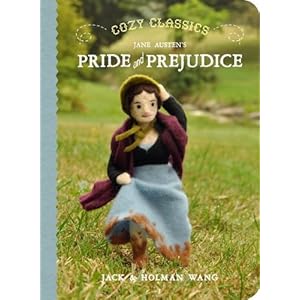
Pride and Prejudice
Jane Austen
London, Everyman's Library, 1991, 368p
This month marks the bicentenary of the publication Pride and Prejudice, arguably the definition of the classic novel. Everyone knows the title, the characters and the plot. Everyone seems to have an opinion on it - whether you think it's the best literature ever written, or the origin of the trashy girly novel. And I think it deserves celebrating.
The Guardian kicked off the party with the 10 best Jane Austen characters (see also their other article about the bicentennial here). My own personal party began with rereading Pride and Prejudice - a novel I have read so often that I can't remember life before it. I first read it in my early teens. It was the kind of thing my mum was in to (she continues to watch period dramas almost every weekend); so, in wanting to emulate her, I embarked on a journey into fin de siecle England, and the mind of Miss Jane Austen.
I found myself in a world full of gowns and dancing, money and wealth, and where family dynamics were central to the plot. Social expectations were mocked or put on trial. Beauty came from within, and girls who exhibited sillyness were just ... silly. But, most quintessentially, it was a world where women were funny and intelligent, and men repeatedly made fools of themselves due to their inability to look beyond their own experience.
For a modern reader, the language may be a little challenging at first. But with a little effort, I found it fairly easy to get past the structure and form, to uncover the wonderful story beneath. And due to the complexity of some of the terminology, as I grow up and learn more, I find something new each time I reread.
Pride and Prejudice is not my favourite Jane Austen novel (see my previous rant about Persuasion), but it has such an incredibly strong cult following, from movies to modern interpretations to the insertion of zombies into the plot. Surely you should read it just so you know what everyone else is talking about!
Eats, Shoots and Leaves
Lynne Truss
London, Profile Books, 2003, 209p
Yesterday morning, I woke to find an angry Facebook post from friend and fellow blogger, The Red Headed Woman, about an example of abuse of the English language on the radio:
Man
on radio claiming he went to Oxford so knows about the "most
brightest"... most bright/brightest. Not that smart are you?
Just hours later, another blogger and my marvellous librarian friend, @Lady_PGD tweeted:
'pilkunnussija' (noun): Finnish: A person with exceptional and
unnecessary attention to detail. Translates literally as
'comma-fucker'
I rather enjoyed finding these glorious examples of how the Internet can be put to good use, as I have just read Lynne Truss' famous attack on poor grammar and punctuation - Eats, Shoots and Leaves. A witty, well-researched rant against all those signs you have seen advertising "book's for sale". Chapter by chapter, Truss outlines the history of our favourite punctuation symbols, and informs the reader of the rules and regulations by which we must abide.
I found the historical information particularly interesting - apparently, the earliest known use of punctuation is credited to a librarian in around 200 BC (yay us!). On reflection, I think I tend to abide by Victorian grammatical rules (in particular, overuse of the comma), as most of what I read is Victorian.
Punctuation, despite changing throughout history, has a significant influence on how we interpret what we read; for example, extracts from the Bible can be read many different ways, if one looks at where the commas and full stops could be placed. Truss expresses concern over the impact of the Internet on punctuation and grammar, as we see these symbols used more often as emoticons than sentence breaks.
Whilst reading this book, I found myself searching for mistakes in Truss' text. I now find myself reading and re-reading this post, in fear of looking like a fool. I highly recommend Eats, Shoots and Leaves; whether you are a confident grammatician looking to confirm what you already know, or a novice in search of clear definitions and examples. Let's end with my favourite:
A woman, without her man, is nothing.
A woman: without her, man is nothing.
The Cornerstone
Nick Spalding
London, Racket, 2011, 266p
After the Christmas break, I fell back into teen fiction with a bang. The Cornerstone is an original and clever adventure, taking you to an alternative world where books hold the ultimate power.
Spalding's novel begins on a rainy Thursday afternoon, when Max Bloom walks into his local public library in search of a cure to his boredom. He wouldn't usually opt for the library, but something beyond his control has drawn him here - something that takes him into the Chapter Lands.
As aforementioned in my entry about The Eyre Affair, I adore stories about world where literature and language are loved and worshipped. In the Chapter Lands, words are powerful. People are trained as Wordsmiths, so they can draw power from books and knowledge. Libraries are protected by armed guards; and education is highly valued, yet only available to a select few, due to fears over giving such power to the people.
Nick Spalding is an entertaining writer, mixing comedy into the action throughout the story. He writes like an omniscient narrator, but is light-hearted and friendly. You get the impression that this story took over him - he did not create it, but was led by it. He has a great appreciation for literature, and clearly loves an adventure.
However, I feel Spalding and his publishers missed a trick with this book. The title refers to the Cornerstone, a book that literally opens up into another world. Using the Cornerstone, Max can step from our world into the Chapter Lands. It is described as old, heavy, and a rich dark green colour. If only the published version of Spalding's story had the same appearance.
Where The Cornerstone succeeds in creating excitement and adventure around literature and language, it fails to deviate from the stereotypes of the librarian. The Head Custodian of the Carvallen library in the Chapter Lands is nicknamed Gandalf, whilst the head of the public library is a middle-aged woman who wears trouser suits and has a bun. She also reads romances. Spalding defines her main duty as chasing overdues.
Fortunately, this public librarian proves to be a powerful woman (secretly, we all are - be warned); but I would love to have seen a fictional librarian who doesn't tie her hear up in a bun. Nevertheless, any book that places literature in such high esteem - donning it with such power - is a winner for me.
The Mrs Marriage Project
Pauline Fisk
London, Faber & Faber, 2005, 260p
After reading so many drama and fantasy novels, I thought it would make a chance to read something a little more feminine.
The Mrs Marriage Project is exactly that. Elin decides her life ambition is to get married. She sets aside her GCSEs and focuses upon researching married life, aiming to get married on her 16th birthday, with or without her parent's permission.
She investigates men - what they want and how she can nab one; she looks at case studies of couples around her, like her unmarried parents; she tries to work out how she can come across as more mature, as this seems the key to becoming a woman.
Many times, I despaired for Elin. So naive in her deturmination, she blocks people out of her life - she convinces herself that she can't tell her friends or family about this mad ambition, because they will be angry, and they won't understand. She spirals out of control, taking refuge with online friendships and fantasy romances.
This novel addresses the problem that many young girls face through their teenage years - that desire to be loved. But Fisk shows us that love is not just about boys and dates and kissing. Love is everywhere, in our relationships with our families and our friends, and even with kind strangers (though not the sort you meet on the Internet).
Quantum of Tweed: The Man with the Nissan Micra
Conn Iggulden
London, Harper Collins, 2012, 74p
I had hoped this short story would be funnier than it turned out to be. The blurb spelt out a brilliant plot, full of comedy and irony, but the Quantum of Tweed was not what I had anticipated.
In a strange series of events, Albert Rossi is mistaken for a world-class assassin. He is in debt, due to the lack of custom at his Gentleman's Outfitters, so quashes his moral concerns and takes on the financially-rewarding challenge of professional murder.
Sounds great, right? Unfortunately, I found the plot wanting. This may be blamed on it being a "quick read", but I have read many brilliant short stories. The potential for comic genius was there, but the tone did not suggest confidence in the comedy. Rossi should have been likable and witty and camp, but was simple and underdeveloped. Even the chapter headings were disappointing - simply labelled "Chapter 1" etc., when they could have been developed into clever puns on classic spy titles.
I did enjoy the situations that Rossi found himself in - he is the luckiest of men. Though not well-trained or experienced, he manages to complete all the assassinations he is paid to do, through fortunate accidents and coincidences. If only the rest of the novel had been as strong.
The Hobbit
JRR Tolkien
London, Harper Collins, 1993, 285p
So here I am, jumping on The Hobbit bandwagon. I tried to read this a few years back, but all I remember now is the excessive singing whilst sat around fires in the forest. Reading it now, there is so much more to Tolkien's story.
I am sure I do not need to tell you the plot of The Hobbit, but just in case - Bilbo Baggins is talked into going on an adventure with thirteen dwarves, over mountains, along rivers and through forests, to reclaim the treasure stolen from the dwarves by the dragon, Smaug. It is Tolkien's prequel to The Lord of the Rings, written for the younger reader.
The language isn't totally accessible for the modern reader, it having been originally published in 1937; but the plot is fast paced and exciting, and Tolkien's narrative tone is light-hearted and easy. The story progresses smoothly and rapidly, and the characters are brilliant - Bilbo in particular, of course. Gandalf repeatedly tells the dwarves that Bilbo will prove to be invaluable, and indeed, this is true. He is their spy and burglar, creeping into all sorts of dangerous situations to gather information or plan an escape.
The action is easy to visualise, especially due to Tolkien's maps and illustrations. Yet, simultaneously, he leaves much to the imagination of the young audience, as his typical reader is probably adventurous and intelligent. It is incredible that a world so far from our reality can so easily come to life!
Like many other Tolkien fans, I am excited to see how this story plays out across the film adaptations, though a little apprehensive about this short tale being converted into 9 hours on screen. I really hope that a product of the release of this film is an increase in readers, young and old, going back to the original adventure story.
The Best Christmas Present in the World
Michael Morpurgo, ill. Michael Foreman
London, Egmont, 2004, 39p
Another masterpiece from Michael Morpurgo. The book itself is beautiful - a small, square hardback covered with Foreman's brilliant artwork. And inside, is a lovely story of hope and love.
The Best Christmas Present in the World is a short story, in which a man finds a wartime love letter in a cluttered antique shop, and seeks to reunite the message with its intended recipient.
The letter is typically Morpurgoan, telling the tale of soldiers on the front line during Christmas in World War One. The events of that day are legendary already, but Morpurgo's re-telling is poetic. He describes the approach of the Germans across no-man's-land, and their day spent playing football and drinking. Morpurgo shows that, even during times of war, peace can come to those who need a little love and hope.
Foreman's artwork is beautiful, just as it was in A Medal for Leroy. He fills the space around Morpurgo's words, bringing the story to life, making it leap from the pages.