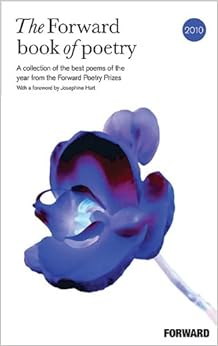
The Forward Book of Poetry 2010
London, Forward, 2010
The 2010 collection is larger than any other Forward Book of Poetry - it contains some of the longest poems I have read in all the anthologies. But it also consists of a wide variety of subjects and forms, and every poems has memorable images and lines.
I am starting to see familiar names recurring in the collections I have been reading - the more you read, the more you know. I was delighted to see Hugo Williams in the 2010 collection - his 'Poems to My Mother' are warm and honest, consistent with his work I have read elsewhere.
Family is a theme that repeatedly comes up in poetry, but none more so than in this collection. It was presented in so many forms - from admiration to anger, tragedy to humour. Many seemed to be saying good bye, such as Christopher James' heart-breaking thoughts on his father. The words portray the individual poet's battles with their relationships; in particular, the darkness of Brian Henry's 'Quarantine' still haunts me.
War and terror seemed to frequently be explored - even ten years after 9/11, the images of this tragedy remain on the minds of the writers. Clive James' ability to find a dark sort of humour in this subject demonstrates the zanity with which terrorism is thought.
Alongside these are reflections on opportunities missed and lives not fulfilled. Roger McGough, a writer I normally associate with humour, declares, "We didn't make our beds, but we lie in them." And Kevin Hart muses over what life could have been like had he taken a different path.
Many different styles were on show in this collection - from structure, rhyming poems to those without punctuation and correct grammar. In places, words seemed to be thrown at random upon the page, until closer reading revealed love or hope or longing.
The ones I loved the most, as per usual, were those written by women, typically about relationships. The 2010 collection gave me a great selection to choose from, including Lorraine Mariner and Selima Hill, aforementioned favourites. But this collection iintroduced me to Tamsin Kendrick, whose weighing up of 'Peter Pan vs Captain Hook' forces you to reflect on your ideal man; especially when paired with Katy Evans-Bush's 'To My Next Lover', which immediately made me go away and write.
What more can you ask of a collection of poetry?
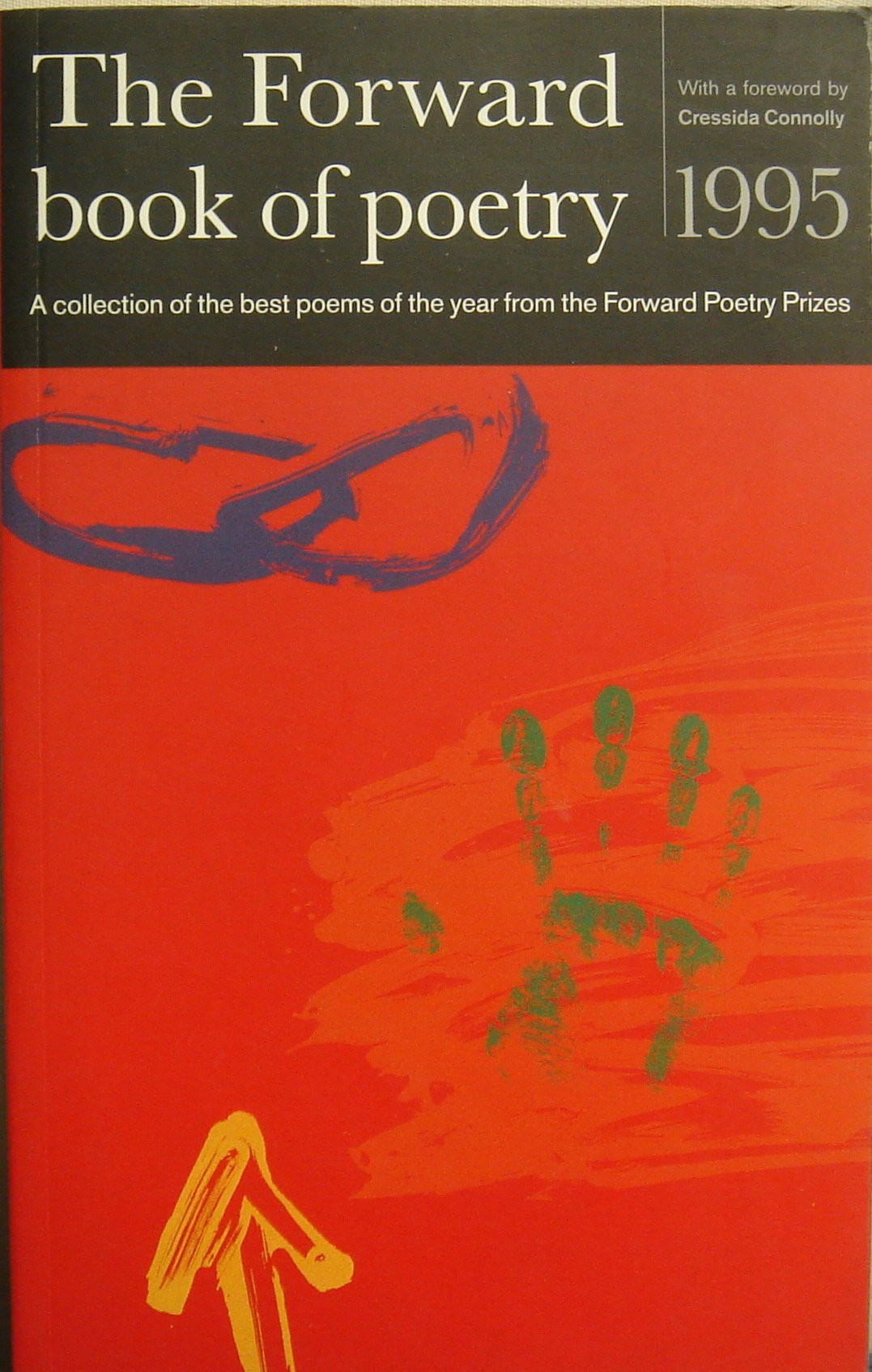
The Forward Book of Poetry 1995
London, Forward, 1995
I love the idea of an impromptu poetry reading from Carol Ann Duffy, Jean Binta Breeze and William Sieghart. Apparently, this is what happened during the meeting of the judging panel for the 1995 Forward Prizes.
As Cressida Connely notes in her foreword, this collection consists of such an incredible variety of poetry, though much of it is rather longer than my usual preference. There are poems about music, from Marvin Gaye to Joe Meek; poems about love and family and loss; and even poems about poems.
Peter Sansom's 'Today We Are Shooting Poets' is a funny, clever piece of writing, in contrast to Ann Sansom's celebration of variety in voices.
There are also brilliantly strong women in this collection, possibly a reflection of Carol Ann Duffy's presence on the selection panel. Helen Dunmore's 'Three Ways of Recovering a Body' is simultaneously tragic and uplifting, but packs a punch alongside the words of Jackie Kay and Louise Hudson.
And there are poems in here I want to read again and again, and that I think might lead me to writing my own response; particularly Peter Didsbury's 'A Malediction', which just oozes inspiration in it's structure, form and subject. Time to get writing, I guess...
The Forward Book of Poetry 2007
London, Forward, 2006
2007 appears to have been the year of the incredibly long poem, and yet this collection is surprisingly short. As John Burnside notes in his foreword, the judges of 2007 selected six finalists for each category, instead of the usual five. But the selection of Highly Commended Poems is shorter than usual, and this is where I found the real gems.
This collection covers as wide a range of themes as any of the Forward Arts Foundation books, but there seems to be a heavier leaning towards poems about the labouring classes than usual, from forestry to mining and beyond.
Then, there are brilliant accounts of fantasy like Tim Wells' 'On Being Expelled from Eton for Shagging Tallulah Bankhead', which imagines a world in which a working class boy could go to an establishment school.
Although many of these poems are rather longer than I typically prefer, there are some excellent examples of experimentation with form, including Allan Crosbie's 'Manifesto', the power of which is so difficult to articulate - you will simply have to read it yourself to believe it.
But I think my favourite is 'Bird' by Clare Shaw - somewhat unexpectedly, as I am not the kind of person who likes stories about animals; I have always responded better to human pain and success. But 'Bird' is so beautifully written, so delicate and innocent, that I could not help but love it.
The Forward Book of Poetry
London, Forward, 1993
My new life rule is that I will always take a collection of poetry with me when I go travelling / holidaying.
I was lucky enough to get away over half term and have a copy of the Forward Book of Poetry 1994 in my small bag of luggage. On quiet nights when I couldn't sleep, I escaped to one of the minute stories in these poems.
1994 was the second year of the Forward Prizes for Poetry, and it feels like quite a different selection from the current winners. Some of the issues explored are the same now as then - relationships, family and happiness are universal - but some are specifically contemporary, a reflection of the politics and technologies of the time.
There are some absolute gems in this collection. Carol Ann Duffy was the winner of the best collection, with her sharp, angry wit; and Vicki Feaver's 'Judith' features, a poem I came across last year when dramatically recited by Poetry by Heart competitors.
Then there is Sylvia Kantaris, one of my earliest poetic loves. During my final year in Exeter, I volunteered at the Heritage Collections, and was responsible for box listing a selection of drafts and notes donated by Kantaris. Reading through her early concepts, I think I first understood how poetry is constructed and crafted, so I was delighted to see 'Animals' in this book.
This collection contains lots of brilliant poetry - humourous, political, romantic - but there were several that were assertive and uplifting that I found myself returning to again and again. Like the sonnet by Sophie Hannah, or Sylvia Dann's little unpunctuated masterpiece, both of which felt like the words could have been mine.
Poetry is powerful in that way - words, written by someone else, can speak to you or reassure you, and it makes you feel safe and whole.
The Forward Book of Poetry
London, Forward, 2014, 175p
It has been a pleasure to read this anthology. Over the few years, my understanding and appreciation of poetry has grown, and I have found some real gems in this anthology.
The Forward Prizes for Poetry are given for success in the publication of a collection, a first collection, and for recognised single poems. Kei Miller was celebrated as the winner of the Best Collection last month, and there is no doubt his writing is original and thought-provoking.
I found old loves and new favourites throughout this collection, some of which I cannot stop myself returning to again and again.
For example, 'Rissotto' by Mary Woodward is right at the back of the collection, and I stumbled upon it one evening when impatiently flicking through the pages. It is delicious, tempting and inviting, and made me immediately hungry. Hugo Williams' conversational style of story telling struck a chord with the common fears we all experience in love and life. And Graham Clifford's 'Best Poem Ever Written' reminded me of one of my favourites from last year, Emily Berry's 'International Poem of the Year'.
But more than any other poet, I love the work of Kevin Powers. The collection has a useful biography section at the back, that informed me Powers was an American serviceman in Iraq; but I could identify that from the emotive and dark realism of his poetry. He writes with anger and guilt, and his words brought tears to my eyes. This is a poet from whom I want to read more.
I am currently working with my creative writing students on responses to current and past commended Forward poets, either in the form of poetry, essays or performance. I have found some great sources for inspiration in this collection - some visual, some historical, some literary. There is a great variety of writing, which I think may be partly due to a great selection of judges. Poems from different cultures and forms are celebrated, and no two pages tell the same story.
Click here to read my other blog and follow what is going on with regards to students' responses to the Forward collections.
The Forward Book of Poetry 2014
Fd. Jeanette Winterson
London, Forward, 2013, 144p
There are so many themes covered in an anthology of this size and quality that every time you open it you find something new - a new form, style or subject.
The Forward Poetry competition celebrates new poetry published each year, producing this incredible collection. Within this book, you have finalists from a number of categories and I enjoyed the variety that afforded.
In terms of some specifics, there were some individual poems that made this anthology something special for me. I am only human, and therefore cannot claim to love every poem I read.
One, called 'The International Poem of the Year' by Emily Berry, described a strange dystopia in which poems are political weapons. Nations banned them, fought over them, and launched them into space. Elsewhere, poems played a "role in pioneering eye operations, contribut[ing] to democracies and charitable works". This poem was excatly what Winterson discusses in her foreward when she describes poems as bombs, giving "us back the words we need so that we can say how we feel".
I was also impressed by the presence of two poems about Sheffield in this collection: 'In Sheffield' by Adam White and Stainless Stephen by Helen Mort. In praise of Sheffield, these poems explored the steel industry through two very different routes, with Mort personifying the industry and White engaging with the history of the city. It felt like home to read these.
Another I wanted to comment upon was Michael Symmons Robert and the two poems from him that are a brilliant addition to this collection. He has an incredible way with words, looking at universal themes of family and love with language that reaches right into your heart and plucks at your deepest dreams and fears.
Poetry is at the forefront of my life at the moment, as we celebrate the wonderful students who have won international competitions. I have high hopes for the young writers at Oxford Spires Academy, who's names will one day fill the pages of anthologies such as this.