Wednesday, 12 December 2012

Lost Christmas


Lost Christmas
David Logan
London, Quercus, 2011, 278p

Christmas is almost upon us now. At work, with the help of my marvelous volunteer, we have created a Winter display, full of books, both fact and fiction, about this cold time of year. We have covered the tree with silver decorations and hung silver tinsel along the desks. I have even received my first Christmas cards, addressed to Miss Librarian and Miss Library Lady, as my name has proved too complicated for them to tackle.

And so, Christmas stories must be read, and must be blogged. My book of choice is Lost Christmas, which I first encountered last year on television, with a brilliant cast, including Sheffield legend and my sister's favourite, Eddie Izzard. As a Librarian, I tend to insist on reading the book before watching the film - but in this case, the television version came first, so I don't feel guilty.

You may notice that this blog post has a lot of tags (see the bottom of the post). That is because it falls into a lot of genres. Lost Christmas is the tale of Goose and Anthony. who meet on Christmas Eve, both having lost something - Goose's dog has run away, and Anthony has forgotten where he came from. In order to find what they are looking for, they must reunite others with their lost belongings, starting with a bangle Goose stole from an elderly widow.

The story is rather a tragic one, full of loss and heartbreak. The characters long to be reunited with loved ones and missing items; they long for what they once had. Predominantly set during the course of one, action-packed day, Anthony and Goose run all over Manchester in order to solve the mysteries they uncover.

My favourite thing about this novel is the random facts Anthony comes out with every now and again. He is portrayed as slightly unstable, claiming to not know how he got to Manchester on this Christmas Eve. He struggles to say what he wants to - the reader is taken through his slow mental process of articulation. But occasionally, the sadness of this novel is softened by Anthony informing us that Coca Cola would be green if they didn't add food colourings. And Thomas Edison invented the light bulb because he was scared of the dark. In isolation, his facts have little meaning or purpose, other than comic relief; but as you read, you realise they add something special to the events of the novel. 

Perhaps a little bit of a sad story with which to start Christmas, but Logan's novel and screenplay (alongside John Hay) are beautiful and optimistic - showing the best in people, in spite of their drama and tragedy.

Tuesday, 11 December 2012

The Truth


The Truth
Michael Palin
London, Orionm 2012, 261p

Those readers of this blog who know me will tell you that I have a little bit of a thing for Michael Palin. It's something about being smart and funny. Also, I think he's a very handsome man. And I do not care about the age difference.

Therefore, I loved reading his fiction. You could really hear his voice and his experiences coming through the pages. The Truth is about Keith Mabbut, a writer who is commissioned to tell the story of philanthropist, Hamish Melville.

Mabbut, being slightly older than most literary protagonists, reminds me of Palin - as I read, I was imagining lovely Michael. He's educated and liberal and probably pretty dashing. Palin draws on his years of traveling for this novel, as Mabbut takes the reader with him around India, Russia and Scotland. 

Once a prize-winning journalist, Mabbut wants to reveal the truth about Hamish Melville - not an easy task, it seems, as Melville is a hard man to track down. He dislikes being interviewed and is suspicious of the arrival of Mabbut. Meanwhile, Mabbut's publishers have different ideas about what constitutes "the truth".

The novel is enhanced by the events of Mabbut's personal life. We learn about his grown up children and his relationship with his wife, from whom he is separated. I wouldn't say the plot is ground-breaking or challenging, but it made for a nice, slow read. It was a refreshing break from the dramatic action stories and hormonal teenagers I have been reading about recently.

And as it is coming up to Christmas, might I suggest it would make a lovely gift.

Friday, 7 December 2012

Message in a Bottle


Message in a Bottle
Valerie Zenatti, trans. by Adriana Hunter
London, Bloomsbury, 2008. 157p

I'm finding that a lot of teen novels fit the bildingsroman category, telling the story of a young girl or boy as they live out their youth and grow into fully rounded adults. Message in a Bottle is no exception.

But there's a twist. This novel is set in Jerusalem and Gaza, documenting the correspondence between Tal and Naim. Following the explosion of a bomb near her home, Tal reaches out for help by sending a message in a bottle to the Gaza strip. She hopes to find a young teenage girl there, who, like Tal, is confused and shocked by the war between the Palestinians and Israelis. Instead, she finds a young man who is disillusioned by the middle east and angry at society. At first, he is rude to her, trying to crush her optimism; but he slowly opens up, as her honesty is impossible to resist.

I found this book to be a bit of an emotional roller coaster. I can never claim to understand what it must be like to be in the position of those like Tal and Naim, but Zenatti did a great job of trying to take me there. I think the most incredible thing is how easy it is to relate to Tal and Naim, despite their distance from the reality of teenage life in England. 

All teenagers struggle to understand their place in the world, and growing up is a process of learning about yourself and others. Tal and Naim portray this perfectly, alongside the backdrop of conflict and death. As such, I hope this novel will make British teenagers realise how good they've got it. 

Wednesday, 5 December 2012

Mortal Chaos


Mortal Chaos
Matt Dickinson
Oxford: Oxford University Press, 2012, 286p

This novel is impossible to put down. It's fast paced, dramatic, and enticing. 

The premise for Mortal Chaos is brilliant - all the characters are interlinked, their actions will affect others, some will die. The chapters are short and tense, skipping between locations and characters at speed. The events seem meaningless in isolation, but together, they form a greater, darker plot. 

Since the blurb suggests "some will die", the reader anticipates danger in every tiny event. The novel is full of potential hazards: from rollercoasters and aeroplanes; to angry, hungry baboons; to climbing Everest. You can't be sure which of these will develop into disaster, and which are just placed there to add to the tension.

Unlike many other books with a lot of characters and situations, Dickinson's work is not complicated or confusing. The links are made clear, and the novel is short enough to progress quickly. Each event is described with clarity and confidence, so that the reader can create a mental map of how everyone and everything links.

It's an incredibly clever novel - so much going on at once, and yet it is so enjoyable. It isn't often that a book makes your heart race, but this novel guarantees excitement. 

Tuesday, 4 December 2012

The Silver Donkey


The Silver Donkey
Sonya Hartnett, ill. Laura Carlin
London, Walker, 2006, 240p

This is a beautiful little novel. In terms of its emotion and language, it's on par with Michael Morpurgo's work.  

The Silver Donkey is set in France during the War. A blind soldier is discovered by two little girls, and a wonderful friendship develops. The soldier wants to get back to his sick brother in England, and the girls long to help - they love the idea of having their little secret. Whilst the children develop an escape plan, the soldier tells them stories, drawing on a little lucky charm he carried - a silver donkey. 

The donkey is a very loaded symbol. The stories that the soldier tells speak of modesty, bravery and self-sacrifice. The soldier tells the children that "the donkey belonged to the trustworthy and the brave". It is so beautiful and shiny that the children long to possess it, but know they must deserve it. It's the kind of moral tale that is subtle enough to seep into the subconscious of the reader.

Hartnett's use of language is incredible. She writes in a way a young child could relate to, processing everything slowly and thoroughly. Her story is full of hope and love and innocence - a perfect tale of friendship between a desperate man and some adventurous children. The book is also full of the illustrations of Laura Carlin, who is simply magnificent - thick, bold sketches full of meaning. 

This story is perfect for all the family. It has the simple beauty of great junior fiction, but would be loved equally by older children and parents for its cleverness and depth.

Monday, 3 December 2012

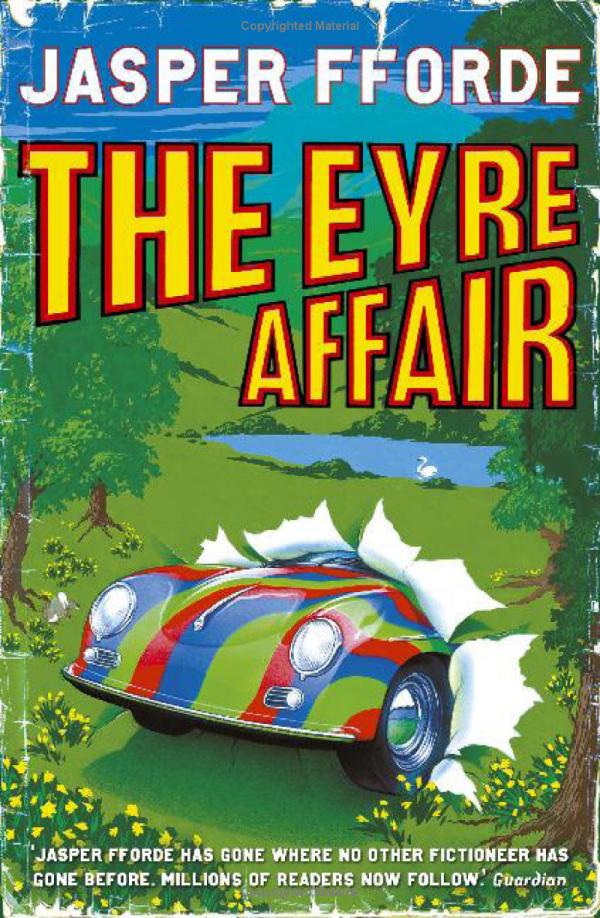
The Eyre Affair


The Eyre Affair
Jasper Fforde
London, Hodder, 2001, 373p

This novel is a diamond. It is clever, original and funny. Jasper Fforde's world, where literature is at the peak of popular culture, is irresistible. 

The Eyre Affiar is every book-lovers heaven. Fforde has created a world we all want to live in: where books and authors are the centre of society; where museums are bursting with visitors; and where there is even a crime department dedicated to investigating literary mysteries.

Thursday Next, Fforde's main character, is one of these investigators, set opposite the most incredible archetypal villian in Acheron Hades, who claims to be evil just for the sake of being evil. The novel begins with the theft of the manuscript of Martin Chuzzlewit and the creation of a machine that opens a portal into the world inside any novel - the Prose Portal. The line between fiction and reality is blurred, as people are able to step in and out of literary classics, and with the potential to alter the course of the plot. 

Fforde's universe is a sort-of alternate reality, where The Crimean War continues to be fought, and Winston Churchill is not a household name, as died from falling out of a tree as a young boy. Central to The Eyre Affair is  - yes, you guessed it - Jane Eyre. You need at least some knowledge of the plot of Bronte's classic in order to understand the plot of Fforde's novel. In Thursday Next's world, Jane Eyre is one of the most popular characters in fiction; yet the plot is not what we know it to be. In Fforde's world, Jane Eyre does not return to marry Rochester at the end of the novel, but she chooses to stay with her cousins, the Rivers. But due to the presence of the Prose Portal, alteration seems inevitable.

I would not hesitate in recommending this novel to anyone. Fforde is a genius - knowledgeable, creative and brave. He has embarked upon an incredible mission - to create an ideal world for book-lovers everywhere. And he has succeeded. Now I need more!