Adventures of a Wimpy Werewolf
Tim Collins
London, Michael O'Mara Books, 2011, 224p
This book is a really fun, easy read. Luke Thorpe is a tragic character - he is school prefect, the victim of being intelligent and hard working. Until he wakes up one morning to find his room ransacked.
He starts developing strange tendencies, like wanting to chase squirrels. He starts craving raw meat. And his body starts changing, getting more hairy. At first he thinks it's rabies, since he was bitten by a dog not long ago; but it turns out he's a werewolf, of course.
It's easy to like Luke, and to feel sorry for him. He wants to do well with his GCSEs, but he also needs to learn to control his changes. Collins is funny and intelligent, just like his character. The element of the supernatural is a great twist on the conventional coming-of-age story.
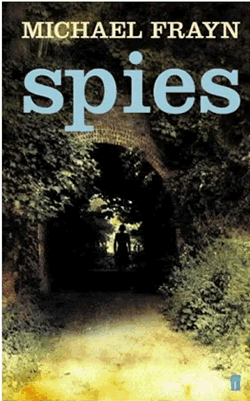
Spies
Michael Frayn
London, Faber, 2002, 234p
This novel is part of my sixth form students' A-level study for English Literature, so I read it in order to support them with their revision.
Spies is the story of Stephen Wheatley, who goes back to the street he grew up on after the smell of a plant drags up old memories of his childhood. He tells the reader about his childhood during the war - his suspicions that his friend's mother might be a German spy, and the consequences of his meddling with her actions. His memories are blurry and inconsistent - some of the events merge into one, or overlap, and it is never clear what was the truth and what was childhood fantasy.
I must admit, I found it a rather challenging book - the story is confused and disorganised, though that is a significant element of the plot. Stephen talks in the third person about his younger self, as if he is watching young Stephen rather than remembering what it was like. It's also all written in the present tense, even Stephen's recollections about his youth. I tend to find this a rather confusing style, but at the same time, I appreciate the effect.
I think the line between adulthood and childhood is an interesting theme in this novel. Children have secrets from adults, either because they are scared of being told of, or because they do not think the adults will believe them. Adults have secrets from children, because it is assumed they will not understand. But all these secrets cause suspicion, which lead to trouble.
Additionally, gossip overlaps with these secrets. The adults in the street talk amongst each other, and when the children overhear, the secrets get mixed with rumour and imagination. The truth gets lost.
I don't envy the students who have to read this for their examinations - it's pretty heavy going. But the themes are clear and interlink easily, so I think revision of the story should be relatively simple.
Noughts and Crosses
Malorie Blackman
London, Doubleday, 2001, 445p
Noughts and Crosses was one of the most talked about books of my teenage years, and somehow it managed to pass me by - I hadn't gotten around to reading it until now.
And, if I am honest, I was a little disappointed. It really did not meet my expectations. I had heard and read so many great reviews, complimenting Blackman's engagement with discrimination and her alternative approach to race; but I thought the novel would be more political and challenging.
I am sure it does not need to be said, but Noughts and Crosses is about a society in which black people rule over and oppress whites. White people are not slaves any more, but they suffer stereotypes and segregation they do not have the same rights to education; and consequently, the Liberation Militia exist in order to protest for white equality. Callum is a nought, a white boy who is ambitious in the face of racism; and Sephy is a Cross, a black girl who also happens to be the daughter of an incredibly powerful man. Of course, their friendship is not acceptable.
I was hoping for something that would make me think - a novel that would make me evaluate myself and the society around me. I was hoping for something that would stay with me for a long time, perhaps would even haunt me for several years.
Unfortunately, I found myself faced with a modern day Romeo and Juliet. The characters were too preoccupied with their teenage angst. I have to wonder if I was a few years younger if I would appreciate the youth of the characters - perhaps I would better be able to relate to their teenage dramas. But I found myself frustrated with the fact the novel centred so significantly around Sephy and Callum, when I wanted to know more about the political aspects of this fictional society.
Also, I really don't like Romeo and Juliet. Why didn't they just talk it over, instead of suffering from miscommunication. And why kill yourself? There is always someone else out there!
I was expecting political drama and I got romance. And not even the format of romance that I like. I had hoped for so much more!
The Beast of Whixall Moss
Pauline Fisk
London, Faber, 1997, 120p
This book is really something - but I think I'm going to struggle to describe it. It is a true mystery, and it may be some time before I truly come to a conclusion on it.
The Beast of Whixall Moss is about Jack and his family. They live in a isolated cottage far from anything, except a creek. Living in a boat on the creek is a young girl, an old grey haired man, and a beast. Jack becomes fascinated with the beast, and with its owners. The beast is beautiful and incredible. It's six headed. And it draws people towards it.
Pauline Fisk writes incredibly well - part of her charm is that she never actually gives anything away. She never fully describes the beast - she just tells the reader how beautiful it is. The beast isn't named. She never really pinpoints the effect it has on those who see it; but through her incredible writing, she draws the reader into her story, in the same way that the beast draws people in.
I feel like this book has had a rather odd effect over me. Jack found the beast to be mesmerising, beautiful, and distracting - he couldn't think about anything else. I think Fisk's story has had the same effect on me... something I find incredible!
Saving Finnegan
Sally Grindley
London, Bloomsbury, 2007, 245p
I struggle to find junior fiction texts that I like. I don't really like stories about animals or "funny" books, as my students call them. And I know I am trying to engage with what my students want to read, but if I can't get through it, there isn't much point in trying.
Saving Finnegan is different, though. It is more confidently written than many books for kids about animals, and it has an actual plot, whereas many animal stories are predictable and boring.
Grindley's book is the story of Holly, who finds a fin whale washed up on the beach of her island one day. The fin whale, named Finnegan, is ill, and Holly protests for her community to help save the poor animal.
The main theme here is death. Grindley hints at it all the way through - first Finnegan's arrival, then the threat of foxes to the hens, as well as Holly's aged grandmother. But those around Holly support her through the trial of acceptance; and I feel the novel would help a young reader in the same way.
This is an enjoyable, optimistic story. Holly represents hope - she is always fighting to help those around her, especially the fin whale.
Jane's Fame
Claire Harman
New York, Picador, 2011, 277p
Claire Harman write cleverly and confidently about the history of the celebrity of Jane Austen - her rise to becoming a well-known household name in the 21st century. She brings together and analyses various biographical accounts of Austen's life, offering new information as well as critiquing existing publications.
I found out some rather interesting facts whilst reading this; one of which was that Mark Twain and Ralph Waldo Emerson didn't rate Jane Austen. It upset me to think that my favourite writers didn't respect each other. I also found it interesting that Austen's novels were a popular subject of study when English Literature was first introduced into universities - her works were considered soft materials for a soft subject, which was predominantly studied by women. And yet, some of her most vocal admirers are / were men.
When reading her novels, I have always found Austen's lack of detail about places, dates and individual's features quite enticing - this has allowed me to imagine my own Captain Wentworth and Mr Tilney. However, Harman argues that this was Austen's attempt to avoid being trapped within a certain era. Many of her novels were published significantly later than written, and therefore could have easily become outdated and old fashioned. In avoiding specifics, Austen allows her stories to fall easily into any time period, so that readers of today can relate to her stories just as easily as her contemporary audience.
In this way, Austen has been adopted as the symbol for many causes. We still don't know much about her life - everything is speculation. Consequently, people can make assumptions, draw links, and use Austen as a figurehead for any cause. She can be paraded as a feminist role model, challenging patriarchal rules, as well as representing the stoicism and peace that the Tory party have used her for.
But that's what I like about Austen. She is different things to different people.
Numbers
Rachel Ward
Frome, Chicken House, 2009, 285p
Whilst avidly searching for an appropriate author to visit my school for World Book Day 2013, I came across Rachel Ward's Numbers trilogy. Fast paced drama and teen angst combine in this tragic story, at the centre of which is death.
When Jem looks into someone's eyes, she can see the date of their death. A series of numbers that spell out a date. She cannot escape these numbers, but she can escape contact with other people, so she protects herself and others by avoiding friendship and companionship.
Unfortunately, however hard one tries to avoid people, sometimes people attach themselves to us. In Jem's case, it's Spider, a fidgety boy from school who insists on being Jem's friend. Unfortunately, Jem knows the date that Spider is going to die.
This novel made me intrigued to know more about Rachel Ward - a typical product of being an English student. Throughout the novel, she debates, whether our lives are planned out for us - are the dates that Jem sees predestined, or is there any way to control them? Jem has very little religious or spiritual faith, and I wonder if this is a reflection of Ward's own ideas.